Although the criterion argument applies to both deduction and induction Weintraub believes that Sextuss argument is precisely the strategy Hume invokes against induction. In this example you can see the difference between premises and conclusion.

The Difference Between Deductive And Inductive Reasoning Daniel Miessler
My dachshund is a dog.
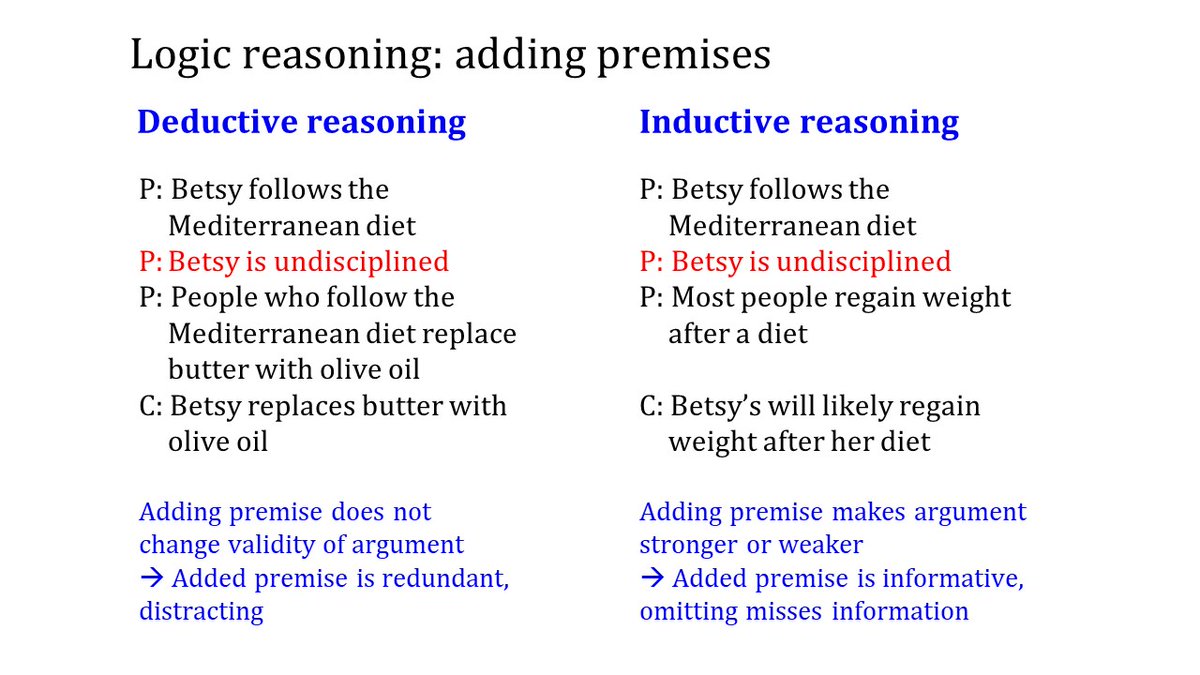
Induction and deduction examples. Inductive reasoning can never lead to absolute certainty. All dogs have fleas premise Benno is a dog premise Benno has fleas conclusion Based on the premises we have the conclusion must be true. Because deduction rhymes with reduction you can easily remember that in deduction you start with a set of possibilities and reduce it until a smaller subset remains.
In logic we often refer to the two broad methods of reasoning as the deductive and inductive approaches. A third coin from the bag is a penny. Jennifer always leaves for school at 700 am.
All men are mortal. One of the classic examples of deduction is the syllogism. An Example of Inductive Deductive and Abductive Reasoning in the Form of a Story.
Sherlock arrives at a crime scene and finds a body blood footprints and a knife. Venus is a planet. Venus is denser towards the middle.
Consider it this way in the form of a story. All planets are denser towards the middle. See if you can tell what type of inductive reasoning is at play.
Because of the limitations of inductive reasoning a conclusion will be more credible if multiple lines of reasoning are presented in its support. Sometimes this is informally called a top-down approach. Here are some examples of deductive reasoning.
Deductive reasoning or deduction is making an inference based on widely accepted facts or premises. It cannot be justified because the purported justification being inductive is circular She concludes that Humes most important legacy is the supposition that the justification of induction is not analogous to that. In this article we are going to tell you the basic differences between inductive and deductive reasoning which will help you to understand them better.
Therefore all the rivers are flowing toward the ocean. Lets take a look at a few examples of inductive reasoning. An example of inductive logic is The coin I pulled from the bag is a penny.
That coin is a penny. When inductive and deductive reasoning were combined to form inductivedeductive reasoning the to-and-fro process of developing hypothesis testable theories inductively form observations chattering their implications by deduction and testing them to refine or reject them in the light of the results formed a powerful basis for the progress of knowledge especially of scientific knowledge. You can utilize the inductive research there is a lack of.
Examples of Inductive Reasoning. O Month of August has experienced drought for the last ten years. Induction and deduction examples.
The first lipstick I pulled from my bag is red. Instead induction allows you to say that given the examples provided for support the claim more likely than not is true. Induction and deduction examples.
Therefore Peter is mortal. For example a murder mystery is an exercise in deduction. The second lipstick I pulled from my bag is red.
Peter is a man. For school today she will be on time. Deductive reasoning works from the more general to the more specific.
Peter is a man. You can induce that the soup is tasty if you observe all of your friends consuming it. Examples of Inductive Reasoning.
All men are mortal. Examples of Deductive Reasoning. Inductive research will allow you to provide the justifiable reason for specific situations by providing examples of real life.
Therefore all the coins in the bag are pennies. To get a better idea of inductive logic view a few different examples. After we examine the inductive reasoning well flip it and see what it looks like in the form of deductive reasoning.
If a beverage is defined as drinkable through a straw one could use deduction to determine soup to be a beverage. In inductive reasoning the approach Specific to General is bottom-up from specific to general see graphic above. Jennifer assumes then that if she leaves at 700 am.
Following are some examples for inductive reasoning. Inductive VS Deductive Reasoning The Meaning of Induction and Deduction with Argument Examples Abbey Rennemeyer If youre conducting research on a topic youll use various strategies and methods to gather information and come to a conclusion. Conversely deductive reasoning uses available information facts or premises to arrive at a conclusion.
Inductive reasoning or induction is making an inference based on an observation often of a sample. Above induction is true for all rivers. O All the rivers I crossed flows toward the ocean.
Limitations of a deductive approach. In the context of the inductive reasoning before beginning the investigation you need to gather information according to the research topics or subject. These two logics are exactly opposite to each other.
Still they are often juxtaposed due to lack of adequate information. Using abductive reasoning he hypothesizes perhaps the knife is a murder weapon and was used to murder this person. Jennifer is always on time.
The conclusions of deductive reasoning can only be true if all the premises set in the inductive study are true and the terms are clear.
Ethanol C 2 H 6 OA compound of carbon hydrogen and oxygenApplications. Examples of pure substances include oxygen water and iron.
Mixture Archives Selftution
A pure substance cannot be physically separated into other substances because all of the particles are the same.
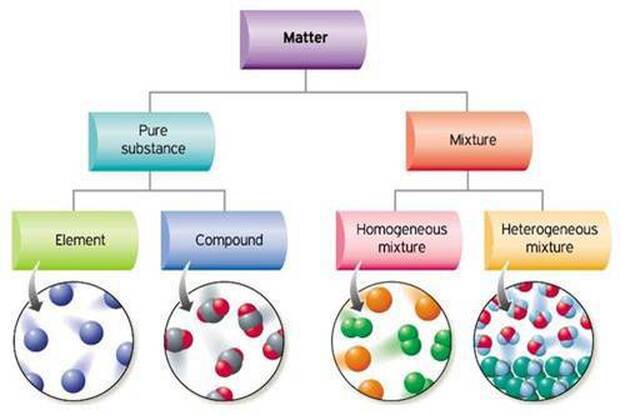
Pure substance and mixture examples. Is used in chemistry in a different way from its everyday. Examples of Pure Substances All elements are mostly pure substances. In the more general sense a pure substance is any homogeneous mixture.
For example suppose you have a mixture of salt and sand and you want to purify the sand by removing the salt. A few of them include gold copper oxygen chlorine diamond etc. If you add corn syrup to the honey you no longer have pure honey.
Pigments additives coatings and often used to. You then end up with pure sand. So in addition to elements compounds and alloys a pure substance might include honey even though it consists of many different types of molecules.
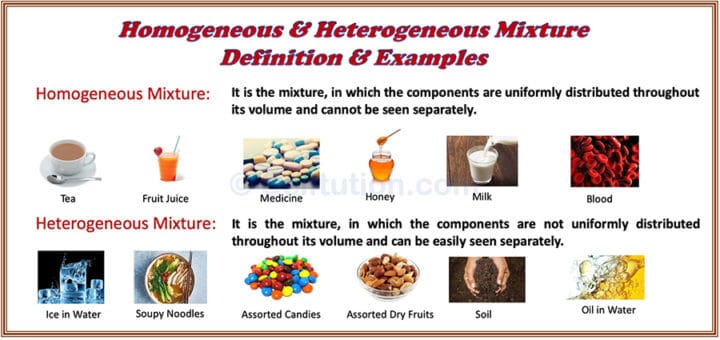
The word pure is used in chemistry in a different way from its everyday meaning. Oxygen water and iron are examples of pure substances. Homogeneous and Heterogeneous Mixtures.
For example shops sell cartons labelled as pure orange juice. Mole The mole is a unit of measurement that denotes an amount of substance also called chemical amount. Mixtures can be either homogeneous or heterogeneous.
Compounds such as water salt or crystals baking soda amongst others are also grouped as pure substances. Pure substances have fixed physical properties such as melting and boiling point. Pure substances have fixed melting points and boiling points and this is very helpful in chemical synthesis to identify unknown substances.
Examples of elements include hydrogen oxygen gold silver Compounds are made up of different types of atoms joined together by chemical bonds. The different substances in a mixture can be elements andor compounds. Examples include water liquid diamond solid and oxygen gas.
A chemical substance is a kind of matter with a definite composition and set of properties. OTHER SETS BY THIS CREATOR. In chemistry a pure substance is a material with a constant composition.
22 A collection of substances is called a mixture. Is carbon dioxide CO2 a pure substance or a mixture. Heres a video from the Evaluate section in the Pure Substances and Mixtures 5E Lesson.
Pure substances have a uniform chemical composition. Is tin Sn a pure substance or a mixture. As a mixture the ice can be separated from the water with physical means such as scooping out the ice fragments.
You can do this by adding water dissolving the salt and then filtering the mixture. The label means that the contents are just orange. Hence Mixture a substance having more than one particle is not called a Pure substance.
13 Best Examples of Pure Substances Simple Explanation 1. The table shows some examples. The known elements listed in the periodic table can be considered pure substances.
This section aims at reviewing and evaluating newly acquired knowle. Pure metals such as Gold Silver and Platinum are good examples for pure solid substances. 23 Mole and amount of substance Main article.
Is chalk CaCO a pure substance or a mixture. Two pure substances mixed together are known as a mixture. Pure Substance and Mixture Examples.
Titanium TiElement with atomic number 22Applications. It doesnt have to. Scientists often use filtration to separate pure substances from a mixture in order to analyze the materials.
That is it is matter that appears uniform in. Pure substances are often called pure to set them apart from mixtures. For example pure water with pure crushed ice in it is still a pure substance but it is also a mixture of two states of the pure substance.
The meaning of pure. What is a mixture. These are often found as solids and can be turned into a molten liquid under high temperatures.
Elements Compounds and Mixtures. A chemical substance can be solid liquid gas or plasma. Examples of compounds include water glucose salt and carbon dioxide.
Pure alcohol could be ethanol methanol or a mixture of different alcohols but as soon as you add water which is not an alcohol you no longer have a pure substance. For example shops sell cartons labelled as pure orange juice. Pure Substance Examples In chemistry a substance is pure if it has a homogeneous chemical composition.
At the nanoscale this only applies to a. Examples of pure substances. A substance can be anything.
Examples of mixtures are air and alloys. Pure substances and mixtures The meaning of pure The word pure is used in chemistry in a different way from its everyday meaning. Alcoholic beverages rocket fuel.
Pure means that the substance has a single type of particle. In other words it is homogeneous no matter when you sample it. Mixture is a combination of two or more pure substances where each substance keeps its own identity upon mixing.