The period number two and three consists of eight elements each and is known as short groups. The periodic table also known as the periodic table of elements is a tabular display of the chemical elements which are arranged by atomic number electron configuration and recurring chemical propertiesThe structure of the table shows periodic trendsThe seven rows of the table called periods generally have metals on the left and nonmetals on the right.

The Periodic Table Properties Of Groups And Periods Science Class Video Study Com
The periods are numbered 1 through 7 on the left-hand side of the table.

What are periods in the periodic table. Each time a pattern started over he started a new row. The elements in the same period are very metallic on the left and nonmetallic on the right. For example the elements sodium Na and magnesium Mg are both in period 3.
Period four and five have eighteen elements and are known as the long group. Arranged this way groups of elements in the same column have similar chemical and physical properties reflecting the periodic lawFor example the halogens lie in the second-last. Atomic number increases as you move down a group or across a period.
Groups and periods are two ways of categorizing elements in the periodic table. As you move from left to right there are no similarities in these elements unlike in the groups but the number of protons and neutrons increases as the masses of the elements get larger. Periodic table in full periodic table of the elements in chemistry the organized array of all the chemical elements in order of increasing atomic number ie the total number of protons in the atomic nucleus.
As Mendeleev was arranging the elements in order of increasing atomic weight he noticed that patterns repeated periodically. A period may be defined as horizontal row in the periodic table. Principal quantum number n.
For example Period 1 represents that the elements lying in that period have only 1 orbit. To remember that groups run along the top of the table imagine a table with musical groups on top of it. The elements in a certain period all increase one by one in atomic numbers.
At the time of this writing the most recent version of the periodic table was approved in December 2018. Periods in the periodic table. The elements astatine At and radon Rn are both in period 6.
A period in the periodic table is any horizontal row of elements. The periodic table allows you to predict the bonding of an atom by allowing you to see the number of electrons in the valence orbital. In terms of electronic structure of the atom a period constitutes a series of elements whose atoms have the same number of electron shells ie.
A period on the. Table shows the changes in the proton numbers and number of valence electrons when going across Period 2. A table of the chemical elements arranged in order of atomic number usually in rows so that elements with similar atomic structure and hence similar chemical properties appear in vertical columns.
A period is a horizontal row of the periodic table. Metal groups are found on the left of the table groups of non-metals are on the right. Each horizontal row of elements in the Periodic Table is known as a period.
Periods In The Periodic Table. A new period begins when a new principal energy level begins filling with electrons. The groups run along the top of the table while the periods run down the side.
The valence orbital is the highest outermost orbital of the atom and is the only one involved in the bonding of the atom. The periods on the Periodic table represents the number of shells or orbits of an atom. A period in the periodic table is a row of chemical elementsAll elements in a row have the same number of electron shellsEach next element in a period has one more proton and is less metallic than its predecessor.
The rows of the periodic table are called periods. An elements period number is the highest unexcited energy level for an electron of that element. Period 1 has only two elements hydrogen and helium while periods 2 and 3 have 8 elements.
There are seven periods in the periodic table with each one beginning at the far left. A period is a horizontal row of elements on the periodic table. Columns of elements help to distinguish groups in the periodic table.
How many periods are in the periodic table. The Periodic Table consists of seven periods from Period 1 to Period 7. The periods of the table are the rows that go from left to right.
In each period horizontal row the atomic numbers increase from left to right. There are 2 elements in the first period ie hydrogen H and helium He. These elements have only 1 electron orbit.
The periodic table is organised in groups and periods. The first period of the modern periodic table is the shortest period as it contains only two elements. Elements that are in the same period have chemical properties that are not all that similar.
Periods are horizontal rows across the periodic table while groups are vertical columns down the table.
The elements of the periodic table sorted by name in an alphabetical list. At Fuse School teachers and animators come together to make fun easy-to-understan.

The Periodic Table Showing Those Metals Classified As Class A Hard Download Scientific Diagram
They are grouped together in the middle to the left-hand side of the periodic table.

The metals on the periodic table. Also many periodic tables have a stair-step line on the table identifying the element groups. The periodic table also known as the periodic table of elements is a tabular display of the chemical elements which are arranged by atomic number electron configuration and recurring chemical propertiesThe structure of the table shows periodic trendsThe seven rows of the table called periods generally have metals on the left and nonmetals on the right. Metals In The Periodic Table So because most elements of the Table are metals it makes sense to begin by looking at them.
The noble gases are almost completely inert. The majority of elements on the periodic table are metals. If you look at the Periodic table you will find that the metal elements are located between atomic number 5 Boron B all the way to atomic number 84 Polonium Po.
IE decreases going down a column of the periodic table and increases from left to right in a row. The metals consist of the alkali metals alkaline earths transition metals lanthanides and actinides. Metals reside on the left side of the table while non-metals reside on the right.
Click on any elements name for further chemical properties environmental data or health effects. Other resources related to the Periodic Table. Metal blue nonmetal yellow or metalloid red.
The types of metals on the Periodic Table can be further broken down by other properties but these are the basic types of metals. Get essential facts about the first 20 elements all in one convenient place including the name atomic number atomic mass element symbol group and electron configurationIf you need detailed facts about these elements or any of the higher numbered ones start with the clickable periodic table. Elements of the periodic table are grouped as metals metalloids or semimetals and nonmetals.
Metals and nonmetals are differentiated on a periodic table because they have different reactivity. Metals In the periodic table you can see a stair-stepped line starting at Boron B atomic number 5 and going all the way down to. The periodic table is the tabular arrangement of all the chemical elements on the basis of their respective atomic numbers.
Metals tend to lose electrons to nonmetals or form metallic bonds with other metals. List of Periodic Table Elements in Hebrew. From left to right in the periodic table the nonmetals can be divided into the reactive nonmetals and the noble gases.
The modern periodic table is based on the modern periodic law put forward by the English physicist Henry Moseley which states that the properties of. One useful way is by metals nonmetals and metalloids. Thus alkali metals have the lowest IE in a period and Rare gases have the highest.
When the elements are thus arranged there is a recurring pattern called the periodic law in their properties in which elements in the same column group have similar properties. The periodic table is organized in families and periods. Using the periodic table you can classify the elements in many ways.
Look up chemical element names symbols atomic masses and other properties visualize trends or even test your elements knowledge by playing a periodic table game. This list contains the 118 elements of chemistry. Periodic table of the elements materials science and academic information elements and advanced materials data scientific presentations and all pages designs concepts logos and color schemes herein are the copyrighted proprietary rights and intellectual property of American Elements.
All of the metals are grouped. In the periodic table the vertical columns are called groups and the horizontal rows are called periods. American Elements is a US.
The line begins at boron B and extends down to polonium Po. Continue exploring the Periodic Table by checking out element examples from all the types of elements. Chemical Evolution of the Universe.
The Elements of Metal. A great summary about Group 1 in the Periodic table - The Alkali Metals. The reactive nonmetals near the metalloids show some incipient metallic character such as the metallic appearance of graphite black phosphorus selenium and iodine.
The periodic table also known as the periodic table of elements is organized so scientists can quickly discern the properties of individual elements such as their mass electron number electron configuration and their unique chemical properties. This periodic table groups elements according to type. Periodic table in chemistry the organized array of all the chemical elements in order of increasing atomic number.
The chemical elements of the periodic chart sorted by. Interactive periodic table with up-to-date element property data collected from authoritative sources. The metalloids separate the metals and nonmetals on a periodic table.
Metals and non-metals in the periodic table. An element can be identified in 3 different ways.
Metals And Non Metals Of The Periodic Table
The nonmetals lis t which makes up the periodic table includes hydrogen helium carbon sulfur nitrogen oxygen radon neon other halogens and noble gases etc.
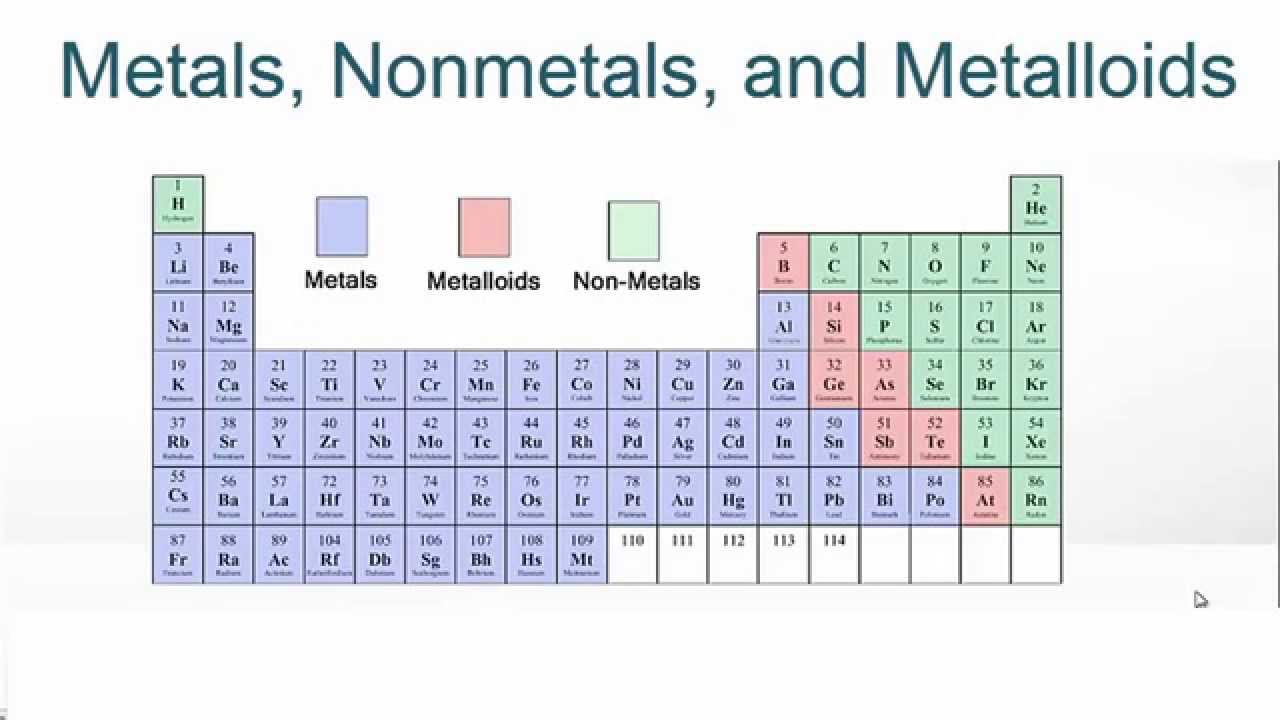
Metal non metal semimetal periodic table. Metalloids are a group of elements that run from Boron to Polonium in the periodic table that bridge the metals and non metals. It divides the metals on the left half of the table from the non-metals on the right side of the table. In the periodic table.
Except for Germanium Ge and Antimony Sb all the elements to the left of that line can be classified as metals. These are elements that exhibit both properties of metals and non metals. An elements position on the Periodic Table tells us whether it is a metal a non-metal or a semi-metal.
Think of it as the prime meridian of the periodic table. Elements present to the left of the line of the periodic table are said as metals though elements present to the far right of the periodic table are said as non-metalsMetalloids or semimetals are present just to the right of metals and possess properties of metals as well as non-metalsHydrogen H is an exception which is the first element of the periodic table and normal temperature and. They are separated by a diagonal band of semimetals.
On the periodic table metalloids are found along a zig-zag line between boron and aluminum down to polonium and astatine. Elements sometimes also classified as nonmetals are the metalloids boron B silicon Si germanium Ge arsenic As antimony Sb tellurium Te and astatine At. They are a group of elements that have a range of properties that are not quite metals and not quite non metals.
Non-metals are found on the far right hand side of the table. Elements to the left of the line are considered metals. Non-metal elements are on the right of the stepped line.
The Metalloids is the term given to the elements in the periodic table that exist between metals and non metals on the right hand side. The metals are to the left of the line except for hydrogen which is a nonmetal the nonmetals are to the right of the line and the elements immediately adjacent to the line are the metalloids. Those diagonals are the metalloids.
Metals are located on the left of the periodic table and nonmetals are located on the upper right. Elements just to the right of the line exhibit properties of both metals and nonmetals and are termed metalloids or semimetals. Metalloids Some elements between the metals and non-metals in the periodic table have properties which are a mixture of the properties of metals and non-metals.
Elements to the far right of the periodic table are nonmetals. Top left Boron and Aluminium bottom right Polonium and Astatine. Nonmetals An approximate way to classify metalloids is to look at the Periodic Table of elements.
The non metalsin periodic table are mainly in the upper right position The only chemical element that is not found in this region of the table is Hydrogen which is located in the upper left corner together with Alkaline Metals but since it behaves in most circumstances as a Non-Metal it is classified as such. Metalloids are chemical elements that display properties of both metals and nonmetals. These elements are called metalloids.
A description and practice of finding metals nonmetals and metalloids on the Periodic TableIn general metals are found on the left-hand side of the period. See the double diagonal line. Usually the semimetals or metalloids are listed as boron silicon germanium arsenic antimony tellurium and polonium.
Properties of Metals Nonmetals and Metalloids are discussed and you see where to find them on the periodic table. A semimetal is a material with a very small overlap between the bottom of the conduction band and the top of the valence bandAccording to electronic band theory solids can be classified as insulators semiconductors semimetals or metalsIn insulators and semiconductors the filled valence band is separated from an empty conduction band by a band gap. The line begins at boron B and extends down to polonium Po.
Metals are found on the left hand side of the table. The metals list which makes up the periodic table includes iron lead gold aluminum platinum uranium zinc lithium sodium tin silver etc. Of course there are those pesky elements residing on the zigzag that dont quite fit in either category.
As there is no widely agreed definition of a nonmetal elements in the periodic table vicinity of where the metals meet the nonmetals are inconsistently classified by different authors. In the periodic table you can see a stair-stepped line starting at Boron B atomic number 5 and going all the way down to Polonium Po atomic number 84. Metals are lustrous good conductors of electricity and readily shaped they are ductile and malleable whereas solid nonmetals are generally brittle and poor electrical conductors.
Semi-metals are found in the region between the metals and non-metals. Metal elements are on the left of a stepped line starting at B-Al-Si. Those elements are dubbed the metalloids.
Non metals in periodic table. Also many periodic tables have a stair-step line on the table identifying the element groups. On many periodic tables a jagged black line see figure below along the right side of the table separates the metals from the nonmetals.